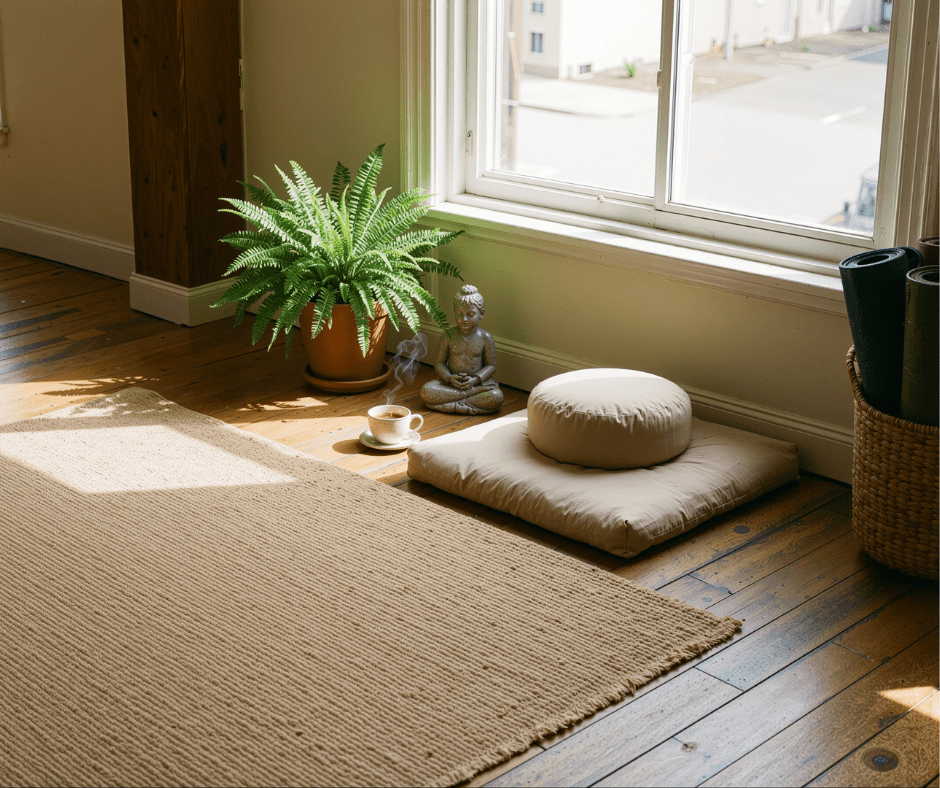
Movement as the first teacher
Long before meditation becomes something we think of as a practice, the body has already begun to teach us how to be. Yoga and dance that both have been big parts of my life introduces attention and presence as a relationship. Sensation speaks, breath responds, effort negotiates with ease.
Here, awareness is not abstract. It is lived. This is not preparation for meditation — it can be meditation in itself, expressed through movement, but for focused and a deepening experience — take the step to the cushion.
When effort gently dissolves
There comes a moment in a practitioners life when effort has nothing left to prove. The body has learned to cooperate rather than strive. What remains is not inactivity, but a different quality of presence. At this point, stillness is no longer a missing part. The meditation cushion appears not as a new technique, but as a place where all doing can finally rest.
Do you like what you are reading? Sign up below for more blog posts.
Resting the mind without trying to fix it
In the Tibetan Buddhist tradition, calm-abiding meditation is known as shinè (Sanskrit and Pāli: shamatha). At its best, this practice is not something we do to the mind, but something we allow the mind to rediscover. Like water left undisturbed, the mind settles when it is no longer interfered with. Stability arises not through effort, but through letting-go.
Seeing clearly while remaining human
Insight meditation — vipassana or laktong — reveals how experience continuously forms and dissolves. Thoughts think themselves. Emotions pass through. Identities loosen their grip. This seeing is not an achievement. It is what becomes possible when we stop insisting on holding on. Clarity, here, is a quality of being present, not a result of effort.
Do you like what you are reading? Sign up below for more blog posts.
The Bodhisattva path as being with others
The Bodhisattva way shifts the center of gravity entirely. Practice is no longer self centered, but about how we inhabit the world and relate to others. Wisdom is measured by how we are present with others, especially when things are inconvenient, uncertain, or uncomfortable. Meditation becomes less about what happens on the cushion and more about who we are becoming in relationship. Being, rather than doing, reveals its ethical dimension. And it’s not about being morally right, but morally good.
When being naturally seeks community
There are moments when this way of being asks to be shared, explored, and articulated together. Not to add more techniques, but to deepen trust in what is already unfolding.
This is the context for an upcoming workshop that I’m offering where we will be exploring the transition from yoga to meditation through shinè, laktong, and the Bodhisattva path. It is the first of three workshops that can be attended separately or as a connected series.
Do you like what you are reading? Sign up below for more blog posts.
You who participate will also have the opportunity to purchase my friend, the buddhist yogi and author Magnus Fridh’s book The Way of the Bodhisattva in Swedish at a discounted price — a grounded companion for those who prefer their wisdom lived rather than performed.
When nothing needs to be added
The movement from the yoga mat to the meditation cushion is not about acquiring something new. It is about recognizing what is already present.
In the best-case scenario, meditation is not a doing.
It is a way of being — attentive, responsive, and quietly available to life as it unfolds.
👉 Read more about the workshops and sign up here:
Yours in the Dharma,
Lama Chimey
Get Dharma Blog Posts straight to your device
 Lama Chimey