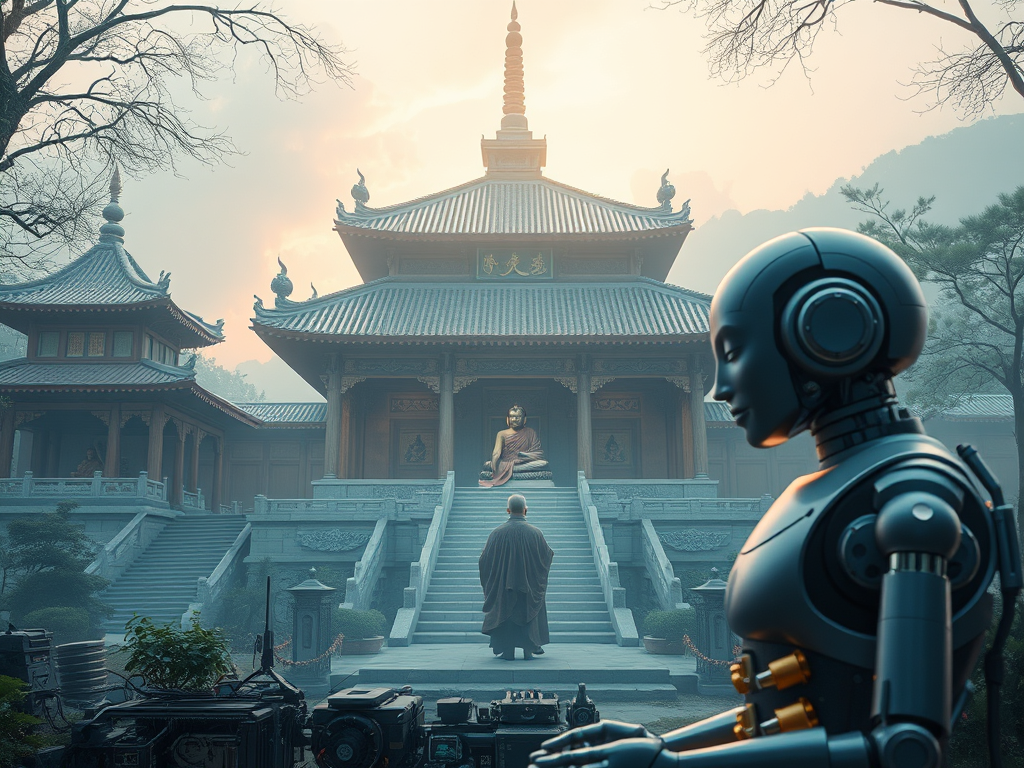
AI Generated Image
The Mirror We Built
Artificial intelligence is a reflection of the human mind — but not the mind in its totality. It mirrors a selected few of humankind: those who design it, fund it, and define its priorities. It does not create greed, attachment, or compassion; it amplifies the tendencies already present in those who shape it. From a Buddhist perspective, AI is a projection of mind (citta-santāna), shaped by craving and aversion.
Do you like what you are reading? Sign up below for more blog posts.
For all of us, and those of you who are leaders in particular, this is not abstract philosophy; it is practice. Each AI-driven decision, each automated process, expresses the mental states that created it. The question is not whether machines can be ethical — but whether we remain vigilant enough to guide them with intention. In my own dharmic blogging, I often write about how small, conscious choices ripple outward in ways we rarely notice. AI magnifies these ripples, making mindful leadership more urgent than ever.
Check out The Inner Wisdom Program for Leaders here.
Intelligence Without Wisdom
For the time being, AI has no access to wisdom (prajñā). It can calculate, predict, and optimize, but it cannot discern the true nature of reality. The Buddha spoke of ignorance (avidyā) — not simply lack of knowledge, but disconnection from absolute reality.
Do you like what you are reading? Sign up below for more blog posts.
Yet we treat AI outputs as oracles, and outsource discernment to algorithms in the hope of certainty. But insight cannot be coded. At least not at this point in time as far as I’m aware. Neither can awareness be delegated. When we mistake data for truth, we fall into the same fog of ignorance — only faster, only more convincingly.
Ethics as Design, Not Decoration
Ethical behavior is not a moral overlay on technology; it is the very seed from which all actions grow. Intention is the root of every effect. A system built on speed, extraction, or self-interest created by a few chosen representatives of humankind it will reproduce those roots endlessly, no matter how many “ethical guidelines” are layered on top.
Do you like what you are reading? Sign up below for more blog posts.
Leadership, then, becomes spiritual practice. Not preaching values, but embodying them through design and action. Asking: Who benefits? Who suffers? What qualities of mind are we cultivating — in ourselves, in our teams, and in the systems we create? Awareness without compassion is incomplete; the two must move together.
The Middle Path in the Machine Age
The Middle Path is about avoiding the extremes of nihilism and eternalism. Applied to AI, it means neither idolizing technology as omniscient, nor demonizing it as inherently corrupt. AI is a mirror — but a mirror of a selected few — revealing both clarity and confusion from a limited perspective.
Do you like what you are reading? Sign up below for more blog posts.
If we meet it with awareness and inclusivity paired with compassion, it can illuminate habitual patterns, loosen unskillful tendencies, and guide more conscious leadership. If we ignore these principles, it simply industrializes delusion. The dharma invites a quiet rebellion: stay awake, lead with mindfulness and compassion, and remember that insight is still the most advanced form of intelligence we know.
Check out The Inner Wisdom Program for Leaders here.
Yours in the Dharma,
Lama Chimey
Get Dharma Blog Posts straight to your device

