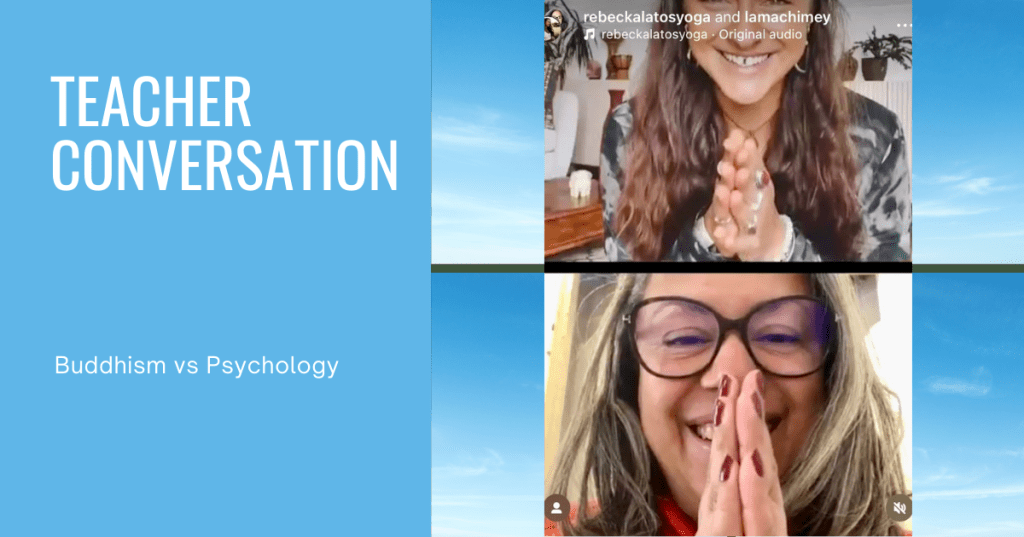
Today, I had the pleasure of sharing a live conversation on Instagram with yoga teacher and healthcare practitioner Rebecka Latoś. It was the final session in our teacher series, and we dove into a topic that’s both relevant and thought-provoking: the relationship between psychology and Buddhism. We explored how these two fields, often seen as separate or even contradictory, can actually complement each other beautifully. You can watch the full conversation on our feeds, and if you’ve been following my work here on The Dharma Blog, you know that this is a topic I’ve delved into before.
Complementary Paths
Buddhism and psychology are not opposites, nor are they rivals. They are complementary paths, each offering profound tools for cultivating compassion, clarity, and personal growth. Psychology often focuses on stabilizing and soothing the ego, promoting mental well-being and emotional resilience. Buddhism, on the other hand, challenges the very notion of a fixed self, guiding us to see through the illusion of permanence and identity.
Do you like what you are reading? Sign up below for more blog posts.
Yet, these approaches don’t have to be at odds. When used with discernment and clarity, they can coexist and even enhance one another. Rather than seeing them as competing philosophies, we can view them as interconnected practices that support and strengthen our inner transformation.
Letting Go of Self-Fixation
One of the core teachings of Buddhism is learning to loosen the grip of our attachment to a fixed self. Clinging to a rigid sense of identity only deepens our suffering, especially when reality challenges that perception. Building resilience and maintaining stability in our sense of self is essential, but it’s equally important to understand that this self is not permanent or unchanging.
Do you like what you are reading? Sign up below for more blog posts.
Psychology helps us soothe and stabilize the ego, making us more prepared to face difficult truths without succumbing to despair. By nurturing emotional health and gaining insight into our behavioral patterns, we create a solid foundation for deeper spiritual practices. This way, when we encounter challenging insights or transformative experiences, we are not overwhelmed but instead prepared to integrate and process them.
Preparation and Guidance
Deep spiritual practices require both preparation and maturity. Authentic guidance is crucial in navigating these profound inner journeys. A skilled teacher serves as a mirror, reflecting our progress and helping us move beyond mere conceptual understanding to direct experience. Without this guidance, it’s easy to become entangled in abstract ideas or misconceptions, mistaking intellectual knowledge for genuine insight.
Meditation vs. Relaxation
One of the most common misconceptions in modern wellness culture is equating meditation with relaxation. While traditional Buddhist meditation can result in a sense of calm, its true purpose is far deeper. Meditation is about realizing your limitless potential and directly experiencing the nature of mind. Relaxation may be a byproduct, but it is not the goal.
Do you like what you are reading? Sign up below for more blog posts.
This distinction becomes crucial when blending Buddhist practices with therapeutic techniques. While relaxation exercises can ease stress, meditation challenges us to look beyond comfort, confronting the raw reality of our thoughts and emotions. Integrating both approaches mindfully can help maintain balance between well-being and transformative insight.
A Holistic Human Experience
Buddhism and psychology together form a holistic map of the human experience. Psychology acknowledges the messiness of being human—our fears, desires, insecurities, and vulnerabilities—while Buddhism points toward the vast potential for liberation beyond these entanglements. Embracing both perspectives allows us to honor our humanity while also aspiring to wisdom and compassion.
Ego Care and Letting Go
Caring for the ego doesn’t mean indulging it, nor does letting go mean dismissing our emotional needs. There is a dynamic balance to be struck. Soothe your ego when it hurts, offer it compassion, but be ready to release it when the time comes. Both acts are expressions of love—one tending to our humanity, the other honoring our potential for liberation.
Do you like what you are reading? Sign up below for more blog posts.
In practice, this means being gentle with yourself during moments of emotional pain while also holding the intention to release clinging. It’s not an either-or situation, but a balanced dance between self-compassion and letting go.
Buddhist Teachings in Modern Psychology
Many modern therapeutic approaches draw directly from Buddhist teachings. Techniques like Mindfulness-Based Stress Reduction (MBSR) and certain cognitive therapies are grounded in foundational Buddhist principles. Early Buddhist texts even outline theories of perception and cognition that align with modern psychology.
For example, the concept of ayatanas (sense bases) explains how perception arises, while conceptual proliferation distorts direct experience. Understanding this process helps us become aware of how our thoughts shape our reality.
The Illusion of Self
One of the most transformative teachings in Buddhist psychology is the concept of anatta—no fixed self. The illusion of a permanent, unchanging identity is a root cause of suffering. By exploring the five aggregates—form, sensations, perception, mental formations, and consciousness—we can see how our sense of identity is constructed. Realizing the impermanence of these elements leads to wisdom and liberation.
Intention and Ethical Conduct
Our intentions shape the outcomes of our actions. Whether in meditation or in daily life, setting a clear and compassionate intention guides our journey toward inner peace. However, meditation alone is not enough to sustain transformation. Ethical conduct is essential for building a stable foundation, providing the integrity needed for deeper insights to take root and flourish.
Embracing Both Paths
Buddhism and psychology don’t need to compete or contradict each other. When approached with clarity and intention, they form a balanced approach to healing and transformation. Both help us navigate the complexities of human experience while pointing to our potential for liberation. To get book recommendations about similar topics, or listen to guided meditations and dharma talks for free, visit my free resources here.
Do you like what you are reading? Sign up below for more blog posts.
Let me know your thoughts on this conversation, and feel free to share your reflections in the comments!
Much Love,
Lama Chimey
Get Dharma Blog Posts straight to your device
 Lama Chimey