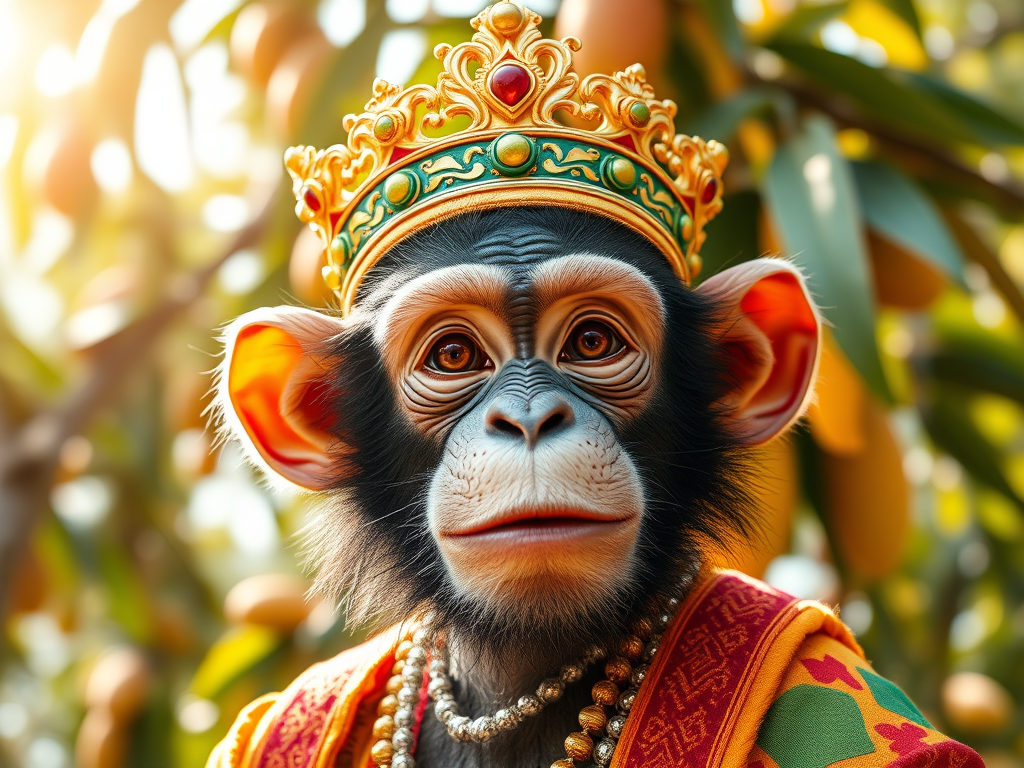
AI image
A story from the Jataka Tales — the early Buddhist tradition of teaching through past-life stories
The Jataka Tales are among the oldest narrative teachings in Buddhism. They describe the Buddha’s previous lives—not as a distant figure, but as someone cultivating wisdom, compassion, clarity, and responsibility over countless lifetimes.
One of these stories is the Mahakapi Jataka, often called The Great Monkey King.
The Story
In a forest along a quiet river lived a tribe of monkeys led by a strong and perceptive leader. High above them grew a mango tree that bore the sweetest fruit they knew. They tended the tree with care, aware that their wellbeing was intertwined with it.
One day, a ripe mango drifted downriver and was found by a human king. Curious—and threatened by the idea that someone else enjoyed this treasure—he followed the river upstream with his army until he reached the forest.
Do you like what you are reading? Sign up below for more blog posts.
When he saw the monkeys eating the fruit, he ordered his soldiers to attack.
The monkey king understood the danger instantly. There was no time to hesitate. He climbed to the highest branch, leapt across the river, and used his own body as a living bridge so his tribe could escape. One by one they crossed over his back to safety. When the last monkey reached the far bank, the king’s strength gave out and he fell.
Witnessing this, the human king was shaken. He saw a form of leadership he had never encountered—rooted in service, not dominance; in clarity, not fear. He ordered his soldiers to stand down.
The mango tree remained untouched.
Why This Story Belongs to Buddhism
In Buddhism, the Jataka tales aren’t merely moral fables. They illustrate how awakening is cultivated through lived experience, through choices made again and again across many lifetimes.
The monkey king is understood as a past life of the Buddha, developing what the tradition calls paramitas—the perfections of generosity, ethical conduct, courage, patience, and wisdom.
Do you like what you are reading? Sign up below for more blog posts.
His act in the story is not about martyrdom.
It is about alignment: seeing clearly, acting responsibly, and offering what the moment requires—even when it costs something.
This is the essence of Buddhist practice:
not grand gestures, but a steady refinement of intention.
What the Tale Offers Us Today
Most of us will never face a moment where we have to become a bridge across a river. Yet we encounter smaller versions of this story all the time:
- choosing responsibility over avoidance
- leading without needing recognition
- acting from clarity instead of pressure
- seeing the whole picture rather than reacting
- supporting others without losing ourselves
The monkey king’s strength mattered.
But it was his clarity that changed everything.
A Question for Quiet Reflection
Where in your life are you relying on sheer effort—pushing, enduring, trying harder—when what’s really needed is a moment of clarity?
What might shift if you led yourself the way the monkey king led his tribe:
with steadiness, vision, and grounded responsibility?
Do you like what you are reading? Sign up below for more blog posts.
In that shift, something opens.
Not in theory, but in the texture of daily life.
Peace,
Lama Chimey
Get Dharma Blog Posts straight to your device
 Lama Chimey